
Quick answer
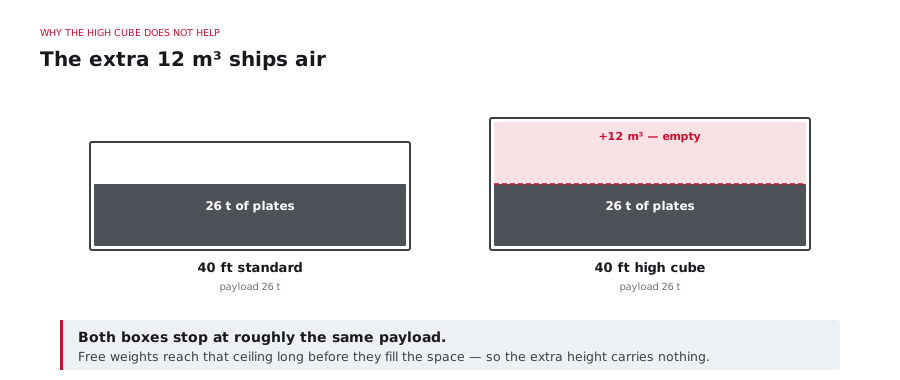
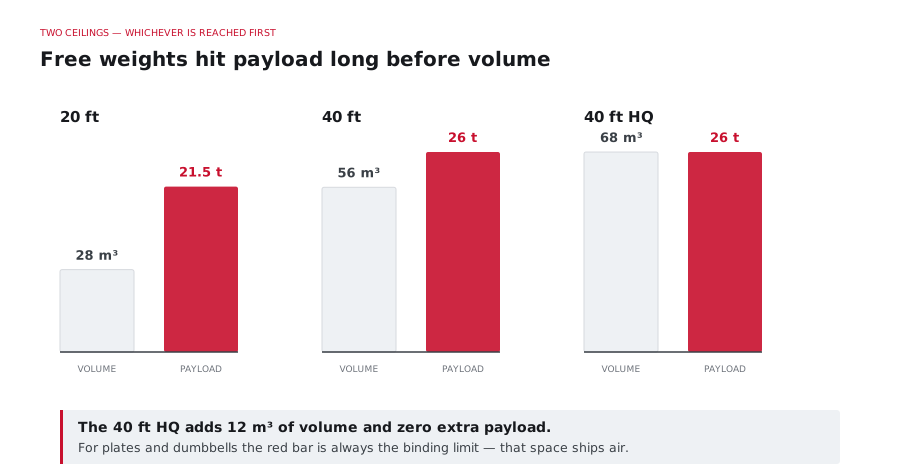
Every container has two ceilings: usable packed volume and gross payload. Free weights almost always hit payload first. A 20ft box takes roughly 28 m³ and about 21.5 tonnes; a 40ft and a 40ft high cube take roughly 56 and 68 m³ but both stop at about 26 tonnes. So the high cube gives you 12 m³ more space and not one extra kilogram of plates. For dense cargo the 20ft is often cheaper per kilogram; the 40ft wins only when you mix heavy goods with light, bulky ones.
Most categories fill a container before they weigh it down. Free weights do the opposite. A pallet of 25 kg plates occupies very little space for its mass, so the box reaches its legal weight limit while a large share of the cube is still empty air — air you are paying ocean freight on.
This catches out experienced importers, because the instinct that a 40ft holds twice a 20ft is correct for almost everything else they buy.
The two ceilings
We plan every load against both limits and take whichever is reached first.
| Container | Usable packed volume | Gross payload |
|---|---|---|
| 20ft standard | approx. 28 m³ | approx. 21.5 t |
| 40ft standard | approx. 56 m³ | approx. 26 t |
| 40ft high cube | approx. 68 m³ | approx. 26 t |
Usable packed volume is lower than the nominal internal volume because pallets, dunnage and stacking limits eat into it. Payload figures vary by shipping line and by road weight limits at the destination — always confirm with your forwarder before fixing a quantity.
Read the table again and the important line is the last one. The high cube adds 12 m³ of space and zero extra payload. For a container of plates, that extra space ships nothing but air.
What that looks like on a real assortment
Take rubber hex dumbbells, 2.5–40 kg, packed in pairs. Each carton is dense: high gross weight, low cube. Load a 40ft with nothing else and the weight ceiling arrives with a substantial part of the box unused.
| Scenario | Limited by | Space left over | Comment |
|---|---|---|---|
| Plates only, 40ft HQ | Payload | Large | You pay for the whole box and ship air |
| Plates only, 20ft | Payload | Moderate | Often the lower cost per kilogram |
| Plates + dumbbells + mats, bags, boxes, 40ft HQ | Both, roughly together | Minimal | The efficient load |
The third row is the point of this article. Heavy goods on the floor, light and bulky goods above them. Training mats, power bags, wall balls and plyo boxes weigh very little for the space they take, which makes them close to free to ship once the heavy cargo has already consumed the payload.
How to work it out for your own order
You need four numbers per line item, and any serious supplier should publish them:
- Units per carton
- Gross weight per carton — not net; the carton and dunnage count against payload
- CBM per carton
- Destination port payload limit — from your forwarder, not from the factory
Then, for each candidate container:
- Divide the payload ceiling by gross weight per carton → cartons allowed by weight
- Divide the usable volume by CBM per carton → cartons allowed by volume
- Take the lower of the two
- Multiply by units per carton → quantity that actually ships
Do this for a 20ft and a 40ft, then divide each freight quote by the resulting mass. The cheaper box per kilogram is frequently not the bigger one.
Three mistakes that show up in real quotations
1. Copying a container quantity from a previous order
Container quantity is a property of an assortment, not of a product. Change the weight mix, change the packing, or change the destination and the answer changes with it. A figure carried over from last year's order is a guess wearing a number's clothing.
2. Treating a container figure as a guarantee
We publish container quantities as planning estimates, and so should anyone else. The final load depends on the actual carton mix, pallet configuration and the road weight limit behind the destination port. Any supplier who guarantees an exact container quantity before seeing your assortment has not checked it.
3. Comparing FOB prices without landed cost
On free weights, freight per kilogram can move the final figure more than a five percent difference in factory price. The cheaper quotation is regularly the more expensive product once it lands.
Work it out for your own order: the container loading calculator takes an assortment and shows the container count, which limit binds first, and the space left over.
Frequently asked
Does a 40ft high cube hold more weight than a standard 40ft?
No. Both are limited to roughly 26 tonnes of payload. The high cube adds about 12 m³ of internal volume, which is useful for light, bulky goods but makes no difference to how many plates or dumbbells you can load.
Is a 20ft container cheaper than a 40ft for free weights?
Frequently, per kilogram. Both containers hit their payload ceiling before they fill up, and a 20ft costs less to ship. The 40ft becomes the better choice when you mix heavy goods with light, bulky items such as mats, bags and plyo boxes that use the space the plates leave empty.
What four numbers do I need to calculate container loading myself?
Units per carton, gross weight per carton, CBM per carton, and the payload limit for your destination. Divide payload by carton gross weight and usable volume by carton CBM, then take the lower of the two results.
Why do suppliers rarely publish container quantities?
Because published figures let a buyer model landed cost independently, which removes a step where a supplier would otherwise control the conversation. It also exposes unrealistic loading claims to arithmetic.
Are published container figures a guarantee?
They should always be treated as planning estimates. The final load depends on your actual assortment, pallet configuration, shipping line and the road weight limits at the destination port.
Why we publish this
Carton counts, gross weights, CBM and container planning figures appear on every product page on this site. Suppliers do not usually publish them, because they let a buyer model landed cost without asking.
We would rather you could. A distributor who can calculate their own landed cost asks better questions, orders a better-balanced first container, and does not come back three months later having discovered that the numbers did not work.
Send us an assortment and a destination port and we will return a loading plan — container count, remaining cube, and where accessories can be added to use it — before the proforma invoice is issued. Send the assortment here.

Written by the people who quote, tool and inspect the product at our own plant. Questions: [email protected]
Request a quotation
Send the list. Get price, lead time and container loading in one working day.
Item list, quantities and destination port are enough to start. Logo artwork and colour references can follow once the price is agreed.
- Email[email protected]
- Phone / WhatsApp / WeChat+86 138 6042 3022
- OfficeIronhue Limited
Room 1203, No.5 Jinzhong Road, Huli District, Xiamen, China