
Quick answer
Competition grade means three measurable things, not a quality claim. Constant external dimensions across every weight, so technique does not change between a 16 kg and a 32 kg. Tight weight tolerance, because a loaded bar must be fair to both lifters. Federation colour coding, so a judge can read the load from across the platform. A commercial-grade product with competition colours is often what a buyer actually wants, and costs considerably less.
Ask ten suppliers for competition kettlebells and you will get ten products. Some will be genuinely to federation specification; others will be a commercial casting in the right colours. Both may be good products. They are not the same product.
What the term actually specifies
1. Constant external dimensions
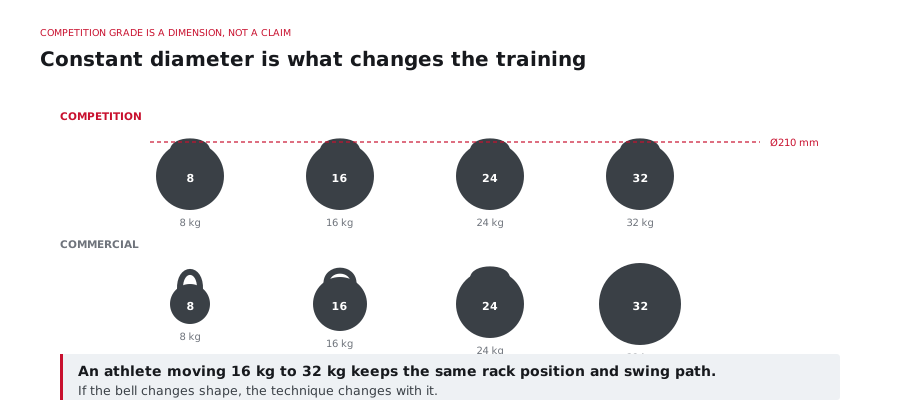
This is the clearest dividing line. A commercial kettlebell grows with its weight: the 32 kg is visibly larger than the 16 kg. A competition kettlebell holds the same shell across the entire range — ours are H280 × Ø210 mm from the lightest to the heaviest, with a Ø35 mm handle throughout.
The reason is training, not aesthetics. An athlete moving from 16 kg to 24 kg during a cycle keeps the same rack position, the same contact point on the forearm and the same swing path. If the bell changes shape, the technique changes with it.
Bumper plates work on the same principle for a different reason: a constant Ø450 mm means the bar sits at the same height off the floor regardless of how much is loaded.
2. Tight weight tolerance
Commercial tolerance is adequate for a gym floor, where nobody is comparing one dumbbell against another. On a competition platform two 20 kg plates load opposite ends of the same bar, and a visible difference in mass is a fairness problem.
| Property | Competition | Commercial |
|---|---|---|
| External diameter | Constant across all weights | Grows with weight |
| Kettlebell shell | H280 × Ø210 mm throughout | Varies by weight |
| Handle | Ø35 mm, usually uncoated for chalk | Often rubber coated |
| Colour | Federation code | Black or brand colours |
| Bumper plate diameter | Ø450 mm constant | Ø450 mm constant |
| Relative cost | Higher | Lower |
Our published tolerances are marked typical rather than guaranteed, and the reason matters: a figure inspected batch by batch is not the same as a figure certified by an independent laboratory. We inspect to the tolerance on the specification sheet. If a federation requires certified figures, that is a third-party test, and a buyer should commission it rather than take a supplier's word.
3. Federation colour coding
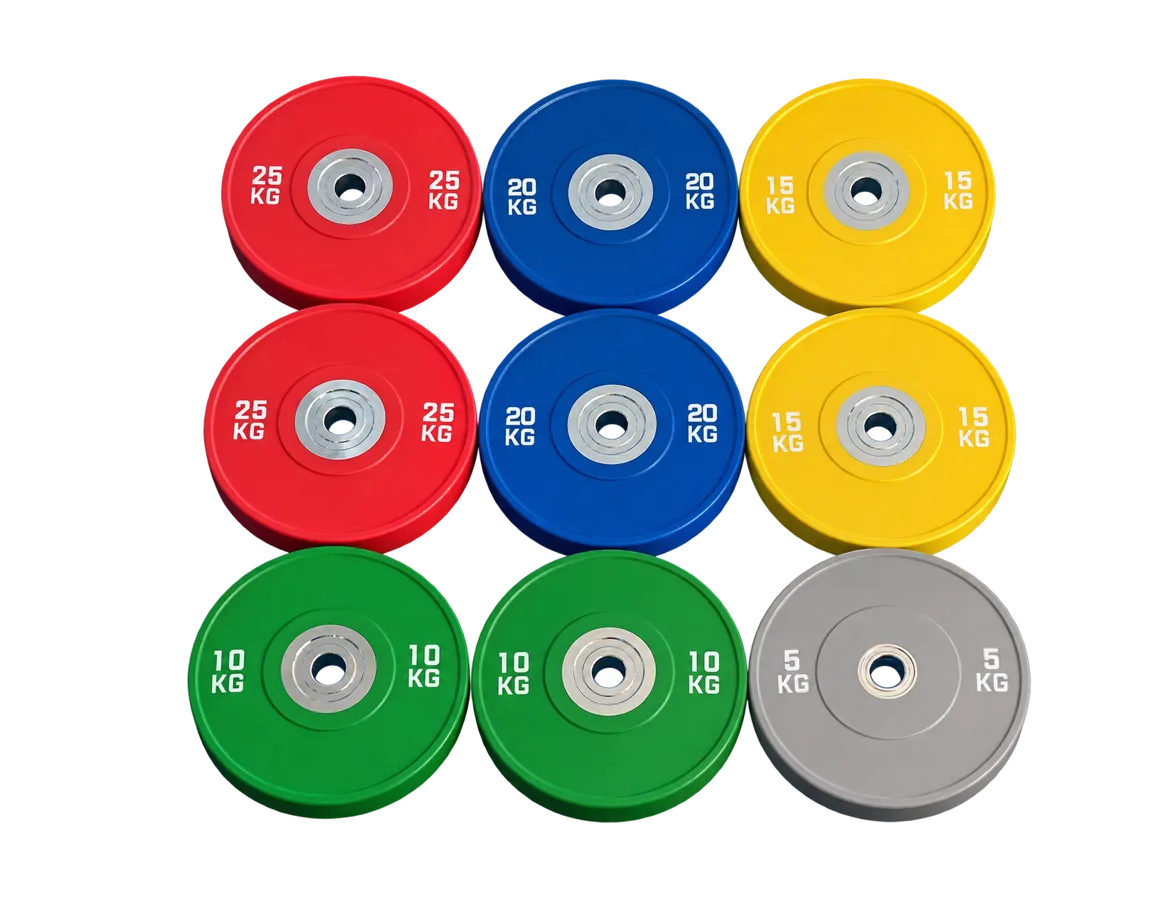
The IWF colour code exists so a judge can read a loaded bar at a distance: red 25 kg, blue 20, yellow 15, green 10, white 5. Competition kettlebells have their own scale — pink 8, blue 12, yellow 16, purple 20, green 24, orange 28, red 32.
Colour is the part buyers most often want, and the part that is cheapest to supply.
The question to ask before quoting
Is this for competition use, or for a commercial floor?
A surprising share of buyers who ask for competition grade want the look: the colour-coded range on the gym floor signals a serious facility. They do not need certified tolerance and they will not be running sanctioned events.
For those buyers, a commercial product in competition colours delivers the visible benefit at a noticeably lower cost. Recommending it costs you margin on that line and earns a buyer who trusts your advice on the next one.
For buyers who genuinely serve federations, training centres or sanctioned events, the specification matters and cutting it is not a favour.
Where the premium is worth paying, and where it is not
| Setting | Competition grade? | Why |
|---|---|---|
| Weightlifting and CrossFit training centres | Yes | Athletes move between weights constantly |
| Facilities hosting sanctioned events | Yes | Equipment must meet federation rules |
| Distributors serving the competition segment | Yes | The specification is the product |
| General commercial floors | No | Nobody measures; constant diameter goes unused |
| Hotel and residential gyms | No | Appearance leads — chrome or urethane suits better |
| Retail and e-commerce | No | Price-led, and the specification is invisible on a listing |
Frequently asked
What makes a kettlebell competition grade?
Constant external dimensions across every weight, tight weight tolerance, and federation colour coding. Ours hold H280 × Ø210 mm with a Ø35 mm handle from the lightest bell to the heaviest, so technique does not change as the athlete moves up.
Why do competition kettlebells all have the same size?
So that rack position, forearm contact and swing path stay identical as the athlete changes weight. If the bell changes shape, the technique changes with it.
Do I need competition grade for a commercial gym?
Usually not. Most buyers who ask for it want the colour-coded appearance rather than certified tolerance. A commercial product in competition colours delivers the visible benefit at a lower cost.
What are the IWF plate colours?
Red 25 kg, blue 20 kg, yellow 15 kg, green 10 kg and white 5 kg. The code exists so a judge can read the loaded weight from across the platform.
Are your competition tolerances certified?
They are published as typical values, inspected batch by batch against calibrated scales. We do not hold independent laboratory certification and do not claim it. Buyers who need certified figures should commission their own testing.

Written by the people who quote, tool and inspect the product at our own plant. Questions: [email protected]
Request a quotation
Send the list. Get price, lead time and container loading in one working day.
Item list, quantities and destination port are enough to start. Logo artwork and colour references can follow once the price is agreed.
- Email[email protected]
- Phone / WhatsApp / WeChat+86 138 6042 3022
- OfficeIronhue Limited
Room 1203, No.5 Jinzhong Road, Huli District, Xiamen, China