
Quick answer
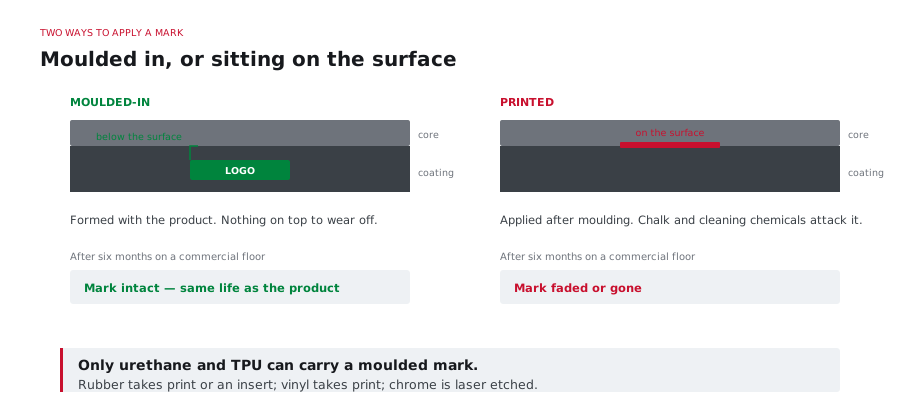
A printed logo sits on top of the coating and wears off. A moulded-in logo is formed inside the material during moulding, so there is nothing on the surface to abrade. Only urethane and TPU can carry a moulded mark; rubber takes print or a moulded insert, vinyl takes print, chrome takes laser etching. Moulding needs a tool per size, which carries a one-off charge that we credit back against the first full container. Artwork to digital proof takes about five working days.
Pad printing looks identical to a moulded mark on day one. The difference appears after a few months of chalk, cleaning chemicals, stacking and being dragged across a rubber floor.
How each is applied
| Moulded-in | Printed | |
|---|---|---|
| When it is applied | During moulding, with the product | After moulding, onto the finished surface |
| Where the mark sits | Below the surface, in the material | On top of the coating |
| Tooling | One tool per size | None |
| Available on | Urethane, TPU | Rubber, vinyl, neoprene |
| Colour options | Contrast colour or same-tone relief | Any print colour |
| Realistic life on a commercial floor | Life of the product | Often less than a season |
Chrome is a third case: the mark is laser etched into the plating, which is durable but limited to a single tone.
Why print fails where it fails
Three things attack a printed mark, and a commercial gym supplies all of them daily.
- Chalk and cleaning chemicals. Gyms clean equipment constantly, and the solvents that remove sweat also attack print.
- Stacking and racking. Dumbbells are dropped onto racks end-first, which is exactly where the logo usually sits.
- Dragging. Heavy pieces get pushed rather than lifted.
In a home or retail setting, none of this happens at the same intensity, which is why print is perfectly reasonable on vinyl and neoprene lines sold into retail.
How the tooling charge works
A moulded logo needs the mark cut into the tool, and a tool covers one size. A range of eight weight increments is eight tools.
Our position on the charge is deliberate:
- It is a one-off, not a per-order fee
- It is credited back against your first full container
- The tool stays in our plant and is not run for anyone else
Buyers often ask us to waive it. We do not, and the reason is worth stating: a tool that costs nothing tends to be treated as though it is worth nothing, and the artwork approval that should take one careful round starts taking four. Crediting it back achieves the same commercial outcome without that effect.
What to send for a proof
Four things, and a proof comes back in about five working days:
- Vector artwork — AI, EPS or vector PDF. A JPG or PNG cannot be cut into a tool.
- Pantone reference if the mark is a contrast colour
- Placement — end cap, side face, handle
- The size range, because that determines the number of tools
Send these together with the rest of the private-label checklist and the whole quotation comes back in one pass rather than three.
A design point most brand owners miss
A moulded mark is read by relief and shadow, not by colour contrast. Fine detail that works on a printed label — hairline strokes, small text, gradients — disappears when it becomes a shallow recess in a matte surface.
Marks that mould well are bold, simple and have generous spacing between elements. If your logo has a detailed version and a simplified version, the simplified one is usually the right choice here.
We return a digital proof precisely so this can be judged before the tool is cut, which is the last point at which changes are free.
Frequently asked
What is a moulded-in logo?
A mark formed inside the material during moulding rather than printed onto the finished surface. Because there is nothing sitting on top of the coating, there is nothing to abrade away.
Which coatings can carry a moulded logo?
Urethane and TPU. Rubber takes a printed mark or a moulded insert, vinyl and neoprene take print, and chrome is laser etched into the plating.
How long does a printed logo last on gym equipment?
On a commercial floor, often less than a season. Cleaning chemicals, chalk, racking and dragging all attack a surface print. In home and retail use it lasts considerably longer.
Is the tooling charge refundable?
It is credited back against your first full container, so an order that proceeds effectively pays nothing for it. The tool remains in our plant and is not run for any other customer.
What artwork do you need for a moulded logo?
Vector artwork in AI, EPS or vector PDF, a Pantone reference if the mark is a contrast colour, the placement, and the size range. A raster file such as JPG or PNG cannot be cut into a tool.
Written by the people who quote, tool and inspect the product at our own plant. Questions: [email protected]
Request a quotation
Send the list. Get price, lead time and container loading in one working day.
Item list, quantities and destination port are enough to start. Logo artwork and colour references can follow once the price is agreed.
- Email[email protected]
- Phone / WhatsApp / WeChat+86 138 6042 3022
- OfficeIronhue Limited
Room 1203, No.5 Jinzhong Road, Huli District, Xiamen, China