
Quick answer
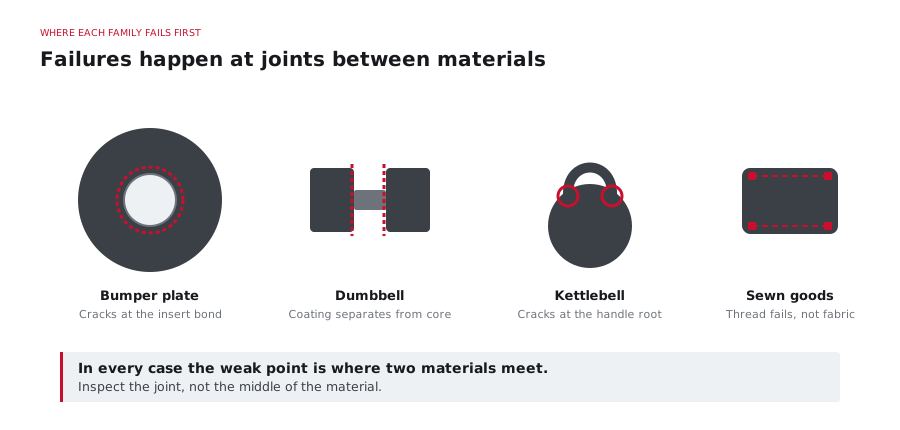
Each family has a characteristic failure point. Bumper plates crack around the steel insert, where hard metal meets flexible rubber and the two deform differently under impact. Dumbbells separate between the coating and the iron core rather than splitting the coating itself. Kettlebells fail where the handle meets the body, which is why competition handles are left bare. Sewn goods fail at the stitching, not the fabric. In every case the weak point is a joint between two materials, not the material itself.
Ask a supplier how long a product lasts and you get a number with nothing behind it. Ask where it breaks and the answer reveals whether they have ever seen one come back.
What follows is how our technical manager describes each failure mode after twenty years of looking at returns. There is a pattern running through all of it, and it is worth stating up front: failures happen at joints between materials, not in the middle of a material.
Bumper plates: the insert, not the rubber
The common assumption is that a bumper plate wears out by the rubber degrading. It usually does not.
The most common failure is cracking around the steel insert. When the plate lands, the impact concentrates at the bond between the insert and the rubber. The steel is rigid, the rubber flexes — they deform by different amounts, so the interface carries the highest stress. Over time the rubber starts to split at the edge of the insert and the crack spreads outwards.
Two other patterns appear less often:
- Cracking from the outer rim inward — usually material ageing or a compound problem
- A loose insert — almost always a press-fitting fault or an out-of-tolerance insert, not wear
The practical consequence: when assessing bumper plates, the insert bond is the specification that matters. Diameter and weight are easy to match; the bond is where cheap plates are cheap.
Dumbbells: separation, not splitting
Coated dumbbells rarely fail by the coating tearing. They fail by the coating letting go of the iron underneath.
Air or moisture gets between the core and the coating during moulding, or the bond was weak to begin with. Under repeated load the interface slowly separates. You notice it as movement between the head and the handle.
Coating that splits open is nearly always external damage — dropped onto a hard edge, struck by another piece of equipment. Under normal use, coating does not crack by itself.
On chrome dumbbells the failure is different again: the plating wears through on the handle where hands grip it, the steel underneath is exposed, and corrosion starts there.
Kettlebells: the handle root
Swings and snatches load the handle where it joins the body. If the coating is thin at that point, or the bond between the casting and the coating is weak, that is where it cracks.
This is one reason competition kettlebells usually leave the handle bare. A bare handle takes chalk, provides adequate grip and removes the failure mode entirely. On coated commercial bells, the handle bond is the thing to ask about.
Sewn goods: stitching, not fabric
Fabric is rarely the problem on power bags and wall balls.
Thread fails first. Under repeated load it abrades, or it pulls through the fabric. The needle holes are a factor too — the hole is a weakness, and under load it widens until the fabric tears from hole to hole.
The distinction worth remembering: abrasion through the fabric is a wear problem and takes time; tearing at a seam is a quality problem and happens early. Double-stitched and bar-tacked anchor points last considerably longer than single-stitched ones, which is why tenders that ask only about fabric weight are asking an incomplete question.
Barbells: reading the bend
A bent bar is the one failure where responsibility is genuinely in question, and it can usually be read from the shape.
| Observation | Points to |
|---|---|
| Bend in the centre, symmetrical | Material strength or heat treatment |
| Bend off to one side, irregular | Overloading, dropping, or uneven loading |
| Failed within a few uses | Likely material |
| Failed after extended service | Likely use |
Before assigning blame, three questions settle most cases: how much weight was loaded, how was the bar set down, and has it been dropped. Bar specification matters here too — a bar chosen for general commercial use will not survive a powerlifting floor.
What this means when you inspect samples
Since failures occur at joints, that is where a sample should be examined:
- Twist the dumbbell head against the handle. Any movement on a new piece is a reject.
- Look closely at the insert edge on a bumper plate. The bond line should be tight and even.
- Flex the kettlebell handle root and check the coating for thinning at the junction.
- Pull hard on a bag handle. Watch the stitching at the anchor, not the webbing.
- Roll a hex dumbbell on a flat surface. A wobble means the heads are not square.
Why no numbers appear in this article
We could state a drop count or a hardness figure. We have not, because we hold no independent laboratory certification for those values and will not present production experience as certified data.
What is described here is different in kind: observed failure modes from two decades of returns and inspections. It is not a substitute for a test report, and where a market requires certified figures, the right answer is to commission testing on samples rather than accept a supplier's number.
Related reading: the rules each of these failures produced.
Written with our technical manager, who has spent twenty years on the floor of a free-weight plant. Figures that would require independent laboratory testing are deliberately not quoted here.
Frequently asked
Where do bumper plates usually crack first?
Around the steel insert. On impact the stress concentrates at the bond between the rigid insert and the flexible rubber, which deform by different amounts. The rubber begins to split at the insert edge and the crack spreads outward.
Why do dumbbells become loose between the head and handle?
The coating separates from the iron core rather than the coating itself splitting. Air or moisture trapped during moulding, or a weak initial bond, allows the interface to separate gradually under repeated load.
Do sewn training bags fail at the fabric or the stitching?
The stitching, almost always. Thread abrades or pulls through the fabric, and needle holes widen under load until the fabric tears from hole to hole. Fabric itself usually wears through slowly rather than failing.
How can you tell if a bent barbell is a material fault or misuse?
By the shape and the timing. A symmetrical bend in the centre suggests material strength or heat treatment; an irregular bend to one side suggests overloading or dropping. Failure within a few uses points to material, failure after long service to use.
Why are competition kettlebell handles left uncoated?
The handle root is where swings and snatches concentrate load, and a coating there is a failure point. A bare handle takes chalk, grips adequately and removes the failure mode.

Written by the people who quote, tool and inspect the product at our own plant. Questions: [email protected]

Request a quotation
Send the list. Get price, lead time and container loading in one working day.
Item list, quantities and destination port are enough to start. Logo artwork and colour references can follow once the price is agreed.
- Email[email protected]
- Phone / WhatsApp / WeChat+86 138 6042 3022
- OfficeIronhue Limited
Room 1203, No.5 Jinzhong Road, Huli District, Xiamen, China