
Quick answer
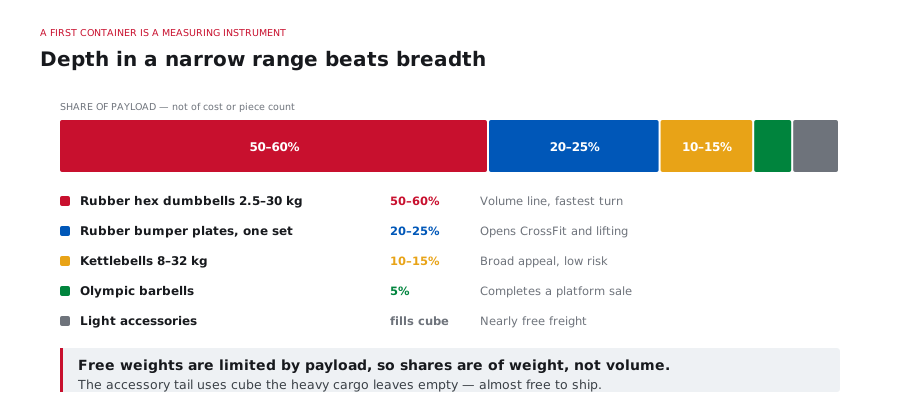
A first container should answer one question: what does this market actually buy? Cover a narrow range in useful depth rather than the whole catalogue thinly. A workable split is roughly 50–60% volume line (rubber hex dumbbells), 20–25% a single bumper set, 10–15% one kettlebell range, a small number of bars, and light accessories to fill the cube the heavy goods leave empty. After six months of sell-through the second container can be built on data instead of guesswork.
A distributor opening a territory faces a genuine dilemma. Carry too little and you cannot answer a customer enquiry; carry too much and you have capital sitting in a warehouse in weights nobody wanted.
The resolution is to accept that the first container is not meant to be profitable on its own. It is meant to tell you what the second one should contain.
A workable first mix
| Line | Share of payload | Role |
|---|---|---|
| Rubber hex dumbbells, 2.5–30 kg | 50–60% | Volume line. Widest customer base, fastest turn |
| Rubber bumper plates, one set | 20–25% | Opens the CrossFit and weightlifting segment |
| Rubber coated kettlebells, 8–32 kg | 10–15% | Broad appeal, low risk |
| Olympic barbells, small quantity | 5% | Completes a platform sale |
| Light accessories | Fills remaining cube | Nearly free freight — see below |
Shares are of payload, not of cost or of piece count, because payload is the binding constraint on a free-weight container.
Depth beats breadth
Given a choice between eight weight increments at shallow depth and five increments in useful quantity, take the five.
A customer who wants 10 kg dumbbells and finds you have two pairs will buy elsewhere and probably not return. A customer who wants 45 kg and finds you do not stock it will accept that and buy the rest of their list from you.
Middle weights sell fastest almost everywhere: roughly 5–25 kg in dumbbells, 10 and 20 kg in plates, 16–24 kg in kettlebells. Start there and extend the range once you know the market.
The accessory tail is close to free freight
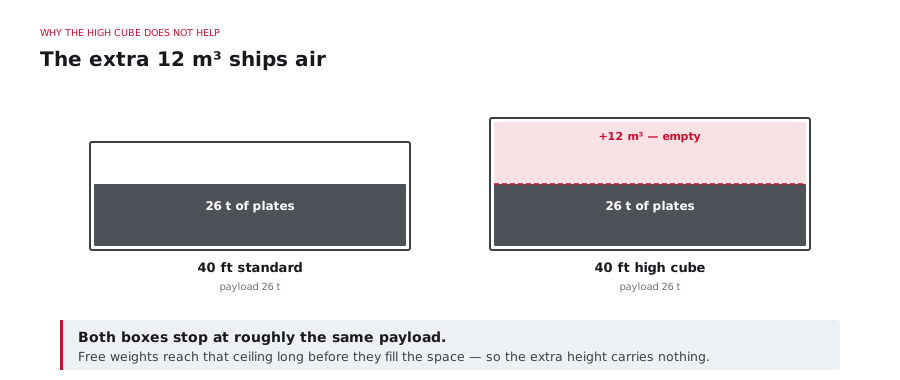
Once the plates and dumbbells have consumed the payload ceiling, a large share of the container volume is still empty. Filling it with light goods costs almost nothing in freight per unit, because the space is going out either way.
Mats, power bags, wall balls and plyo boxes all qualify. They also happen to be the items a gym customer adds at the end of a quotation, which makes them useful to have on the shelf.
One tier, not three
It is tempting to carry rubber, TPU and urethane so you can serve every enquiry. On a first container this usually splits your depth three ways and leaves you thin in all of them.
Carry one tier in depth and quote the others from the factory against confirmed orders. Once you know which tier your market actually pays for, stock accordingly. The coating comparison is worth reading before you choose, but for most new territories the answer is rubber.
What to measure over the first six months
Track four things per SKU. Everything else is noise at this stage.
- Weeks of cover — at current rate, how long does the stock last?
- Enquiries you could not fill — the most valuable number, and the one nobody records
- Customer type — gyms, retail, PT studios, online
- Requests for a tier you do not stock — tells you whether to move up or down
The second one deserves a note. Lost enquiries are invisible in your sales data by definition, so they have to be logged deliberately. A single shared sheet where anyone writes down “asked for X, we did not have it” is worth more than most inventory systems when you are planning container two.
Building the second container
With six months of data the exercise becomes arithmetic rather than judgement: extend the SKUs that sold through, cut the ones that did not, add the tier your customers kept asking for.
Send us the sell-through and we will run the loading plan against it, including how much cube is left and what could fill it.
Related reading: what a trial order is actually evaluating.
Work it out for your own order: the container loading calculator takes an assortment and shows the container count, which limit binds first, and the space left over.
Frequently asked
What should a distributor put in a first container of free weights?
Roughly 50–60% of payload in a volume line such as rubber hex dumbbells, 20–25% in a single bumper plate set, 10–15% in one kettlebell range, a small number of barbells, and light accessories to fill the remaining volume.
Should a first container cover the whole product range?
No. Depth in a narrow range beats breadth across the catalogue. A customer who cannot get the weight they want in quantity buys elsewhere; a customer who cannot get an unusual size will still buy the rest of their list from you.
Which weights sell fastest in a new market?
Middle weights, in most territories: roughly 5–25 kg in dumbbells, 10 and 20 kg in plates, and 16–24 kg in kettlebells. Extend the range outwards once sell-through data exists.
Why are accessories described as almost free freight?
Because free weights hit the container payload ceiling long before the volume ceiling. Light, bulky goods such as mats, bags and plyo boxes use space that is shipping empty anyway.
Should a first container carry more than one coating tier?
Usually not. Carrying three tiers splits your depth three ways. Stock one tier properly and quote the others from the factory against confirmed orders until you know which tier the market pays for.

Written by the people who quote, tool and inspect the product at our own plant. Questions: [email protected]
Request a quotation
Send the list. Get price, lead time and container loading in one working day.
Item list, quantities and destination port are enough to start. Logo artwork and colour references can follow once the price is agreed.
- Email[email protected]
- Phone / WhatsApp / WeChat+86 138 6042 3022
- OfficeIronhue Limited
Room 1203, No.5 Jinzhong Road, Huli District, Xiamen, China